




Franking credits allow an Australian company to pass on credit for tax it has paid when distributing profits. For an eligible shareholder, this reduces the risk of the same profit being taxed once in the company and again in full after distribution.
The calculation may look simple, but a valid franked dividend depends on more than the company tax rate. Directors must consider the franking account balance, the correct imputation rate, the benchmark rule, the recipient’s eligibility, and the company’s ability to pay the dividend.
What Are Franking Credits?

A franking credit represents Australian income tax paid by a corporate tax entity. The company records these credits in its franking account and may attach them to a frankable distribution.
The franking account is a statutory record rather than cash the company can spend. Credits commonly arise when the company pays PAYG instalments or income tax, or receives a franked distribution from another Australian company. Debits commonly arise when the company pays franked distributions or receives certain tax refunds.
How Does the Dividend Imputation System Work?
The process generally works as follows:
- The company earns taxable profit.
- It pays tax at the applicable company rate.
- The payment creates a credit in its franking account.
- The company attaches some or all of the available credit to a dividend.
- An eligible shareholder includes the cash dividend and attached credit in assessable income, then claims the credit as a tax offset.
Before paying a dividend, directors must also satisfy section 254T of the Corporations Act 2001. The company’s assets must exceed its liabilities by enough to cover the dividend, the payment must be fair and reasonable to shareholders as a whole, and it must not materially prejudice the company’s ability to pay creditors.
Reliable company tax return support helps keep taxable income, tax payments, and the franking account aligned before directors approve a distribution.
How Are Franking Credits Calculated?
The maximum credit that may attach to a fully franked dividend is:
Cash dividend × [corporate tax rate for imputation purposes ÷ (1 − that rate)]
The relevant rate is generally 25% or 30%. A company is usually a base rate entity for an income year when its aggregated turnover is below $50 million, and 80% or less of its assessable income is base rate entity passive income.
The company tax rate and the corporate tax rate for imputation purposes are related, but they do not always use the same year’s circumstances. The imputation rate for a distribution commonly depends on the company’s turnover and passive-income position in the previous income year. The ATO’s company tax rate guidance explains how the tests apply.
Example: Franking a $75,000 Cash Dividend
| Assumed imputation rate | Calculation | Maximum franking credit | Grossed-up amount |
| 25% | $75,000 × 25/75 | $25,000.00 | $100,000.00 |
| 30% | $75,000 × 30/70 | $32,142.86 | $107,142.86 |
These are maximum amounts. The company must also have enough credits in its franking account and apply the correct benchmark percentage.
Fully Franked, Partially Franked, and Unfranked Dividends
The terms describe how much credit is attached to a distribution:
- Fully franked: The maximum allowable credit is attached.
- Partially franked: The distribution carries less than the maximum credit.
- Unfranked: No franking credit is attached.
Credits sit in a pooled account, so they do not need to come from the same year’s profit as the dividend. Tax losses, offsets, refunds, and differences between accounting profit and taxable income can still affect the available balance.
How Are Franked Dividends Taxed for Individual Shareholders?
An eligible Australian resident individual generally includes the cash dividend and attached credit in assessable income. The credit then reduces the person’s income tax liability and may be refundable if it exceeds the tax payable, subject to the integrity rules.
Assume a company using a 25% imputation rate pays a $75,000 fully franked dividend:
- Cash dividend: $75,000
- Franking credit: $25,000
- Grossed-up assessable amount: $100,000
If the shareholder’s other income places the whole additional amount in the 45% tax bracket, and the 2% Medicare levy applies, the illustration becomes:
- Tax and Medicare levy on the grossed-up amount: $47,000
- Less franking tax offset: $25,000
- Additional amount payable: $22,000
- Dividend cash remaining after that amount: $53,000
This is an illustration only. Progressive rates apply when the shareholder is not already in the top bracket, and other offsets, levies, and circumstances may change the result.
Can Franked Dividends Pass Through a Family Trust?
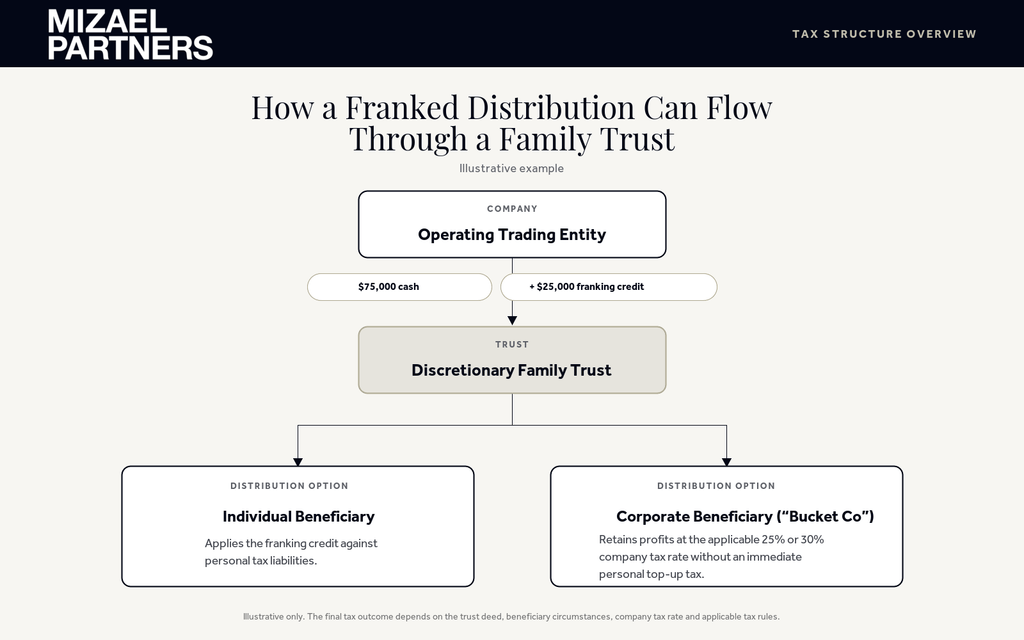
A discretionary family trust that owns company shares may receive a franked dividend. The trustee can stream that distribution to a beneficiary when the trust deed permits streaming, the resolution is valid and timely, and the beneficiary becomes specifically entitled to the franked distribution.
The credit must follow the dividend. It cannot be streamed to one beneficiary while the related dividend is allocated to another. The ATO’s trust streaming guidance explains the specific-entitlement requirements.
Distribution to an Individual Beneficiary
An eligible individual beneficiary includes their share of the franked distribution and credit in assessable income. They may then claim the corresponding tax offset, subject to the holding-period and other integrity rules.
Distribution to a Corporate Beneficiary
A corporate beneficiary, often called a bucket company, includes its grossed-up share of trust income and may claim the related tax offset. Excess franking credits are generally not refundable to a company.
Distributing income to a bucket company may defer higher individual tax, but it does not eliminate that tax. A further liability may arise when the company later distributes its retained profits to individual shareholders.
If the trust does not pay the company’s entitlement, an unpaid present entitlement, or UPE, may arise. In Commissioner of Taxation v Bendel [2026] HCA 18, the High Court held that a corporate beneficiary’s UPE is not automatically a Division 7A loan merely because the trustee retains the funds.
The decision is not a general exemption from Division 7A. A separate loan, payment, debt forgiveness, financial accommodation, or benefit involving a shareholder or associate may still create a deemed dividend.
What Proposed Trust Tax Changes Could Affect Franking Credits?
The 2026–27 Federal Budget announced reforms that could change the tax outcome for discretionary trusts and bucket companies. The main proposals are:
- 30% minimum tax: The trustee would pay a minimum tax of 30% on relevant trust income from 1 July 2028.
- Beneficiary offsets: Eligible non-corporate beneficiaries could receive a non-refundable offset for tax paid by the trustee.
- Corporate beneficiaries: A bucket company would not receive an offset for the minimum tax paid by the trustee under the current Treasury model.
- Excess franking credits: Treasury is considering whether these credits should be refunded to the trustee or carried forward.
- Restructuring relief: Eligible trusts could access expanded rollover relief for three years from 1 July 2027.
The Government is separately considering an earlier proposal to bring corporate beneficiary UPEs expressly within Division 7A following Bendel. These measures were not law as of 30 August 2026, and their final design may change. Any trust or bucket-company strategy should therefore be reviewed once legislation is introduced. See the Treasury consultation on the proposed trust reforms.
Can an SMSF Receive a Refund of Excess Franking Credits?
A complying SMSF may use eligible franking credits to reduce its tax liability. Any remaining credit may be refundable after the ATO processes the fund’s annual return.
In the accumulation phase, assessable income is generally taxed at 15%. Credits linked to profits taxed at 25% or 30% may therefore exceed the tax attributable to the dividend. Income from assets supporting retirement-phase income streams may also qualify as exempt current pension income.
Whether the fund receives a refund depends on several factors:
- Compliance status: The SMSF must remain complying.
- Integrity rules: The fund must satisfy the holding-period and related requirements.
- Overall tax position: Other income, deductions, and the proportion supporting retirement-phase income streams affect the calculation.
- ATO debts: The ATO may apply the refund against an outstanding debt.
SMSF accounting services can help trustees record distributions and apply the credits correctly.
How Can a Company Avoid a Franking Deficit?
A franking deficit arises when the account has more debits than credits at the relevant balancing time. For a standard 30 June balancing company, this generally requires a franking account tax return and payment of franking deficit tax by 31 July.
The resulting tax offset is generally reduced by 30% when the franking deficit tax liability attributable to specified debits exceeds 10% of the total franking credits arising during the relevant year. Reconciling the account before declaring a dividend helps identify a potential shortfall.
What Is the Benchmark Franking Rule?
The benchmark rule generally requires a private company to frank all frankable distributions made during the same franking period to the same percentage. The first distribution establishes the benchmark.
Franking a later distribution above that percentage may lead to over-franking tax. Franking below it may create an under-franking debit. The rule prevents a company from directing a greater share of its available credits to selected shareholders.
What Is the 45-Day Holding Rule?
A recipient generally must hold shares at risk for at least 45 continuous days to qualify for the attached credits. The acquisition and disposal days do not count. The period increases to 90 days for certain preference shares.
An eligible individual may use the small shareholder exemption when their total franking credit entitlement for the income year is below $5,000, and the related-payment rule does not apply. Trust distributions require additional care because the qualified-person requirements may affect both the trustee and the beneficiary.
Which Other Integrity Rules May Apply?
Franking credits can be denied or adjusted even when the basic calculation is correct.
Capital-Funded Distributions
Section 207-159 may prevent a distribution from being frankable when it is funded by a capital raising, falls outside the company’s established distribution practice, and satisfies the statutory purpose and effect requirements. A capital raising or an unusual dividend does not trigger the provision by itself. The complete arrangement must be considered.
Section 100A and Trust Distributions
Section 100A may apply where a beneficiary is made entitled to trust income, another person receives the economic benefit, and the arrangement has a tax-reduction purpose. The provision does not apply to an arrangement entered into in the course of an ordinary family or commercial dealing.
If section 100A applies, the beneficiary’s entitlement may be disregarded, and the trustee may be taxed at the rate applying under section 99A. The franking-credit treatment must then be reconsidered under the trust rules. An ATO audit review may help identify weaknesses in an existing arrangement before they develop into a formal dispute.
Plan Franked Dividends Before Making the Payment
A franked dividend requires more than selecting a percentage. Directors should confirm the imputation rate, available franking balance, benchmark percentage, corporate-law position, and the recipient’s eligibility before approving the distribution.
Mizael Partners’ business accounting services help private companies reconcile franking accounts and assess distributions involving shareholders, trusts, and corporate beneficiaries. Contact Mizael Partners before finalising a significant dividend or trust distribution.
This article provides general information as of 30 August 2026. It does not constitute tax or legal advice.